Build a Better Bond Through Positive Training
Good dog training starts with reward-based basics: name response, sit, down, stay, leash walking, recall, and calm behavior around daily distractions. Keep sessions short, reward the behavior you want, and build one habit at a time.
Dog Training: The Complete Guide to Essential Commands & Behavior
Our Training Philosophy
At Puptify, we believe that the strongest training isn’t built on fear , it’s built on trust. Every recommendation in this guide is grounded in modern behavioral science and endorsed by the American Veterinary Society of Animal Behavior (AVSAB) and the Australian Veterinary Association (AVA). Both formally recommend reward-based training over aversive methods, citing improved learning, reduced behavior problems, and a better quality of life for dogs.
Why Positive Reinforcement Works
Positive reinforcement (R+) means adding something pleasant , a treat, praise, a toy, or play , immediately after a desired behavior to make that behavior more likely in the future. The equation is straightforward: Dog sits → gets a treat → dog sits more often.
A landmark study by Rooney & Cowan (2011) in Applied Animal Behaviour Science found that dogs trained with reward-based methods scored higher in obedience and had stronger bonds with their owners. A 2020 study confirmed punishment-based training is linked to increased stress, fear, and aggression.
The Three Quadrants Ethical Trainers Use
- Positive Reinforcement (R+) , Add something good to increase a behavior.
- Negative Punishment (P-) , Remove something good to decrease a behavior (e.g., withdraw attention when a puppy jumps).
- Negative Reinforcement (R-) , Used only in specific, humane contexts (e.g., removing a trigger when a dog shows calming signals).
What ethical trainers never use: Positive Punishment (P+) , leash jerks, yelling, shock collars, prong collars, alpha rolls. Punishment activates fight-or-flight and can cause learned helplessness or aggression. It suppresses behavior without teaching a replacement.
The “Dominance” Myth
The dominance/alpha theory has been thoroughly discredited. Modern science tells a different story: dogs are motivated to control resources , a survival instinct. Benevolent leadership through clear, kind communication is the effective modern approach. You don’t need to be a “pack leader.” You need to be a patient, consistent teacher.
8 Essential Commands: Step-by-Step Protocols
Every command below is taught without force. Keep sessions short , 5, 10 minutes for puppies, 10, 15 minutes for adults. Always end on a positive note.
1. Sit
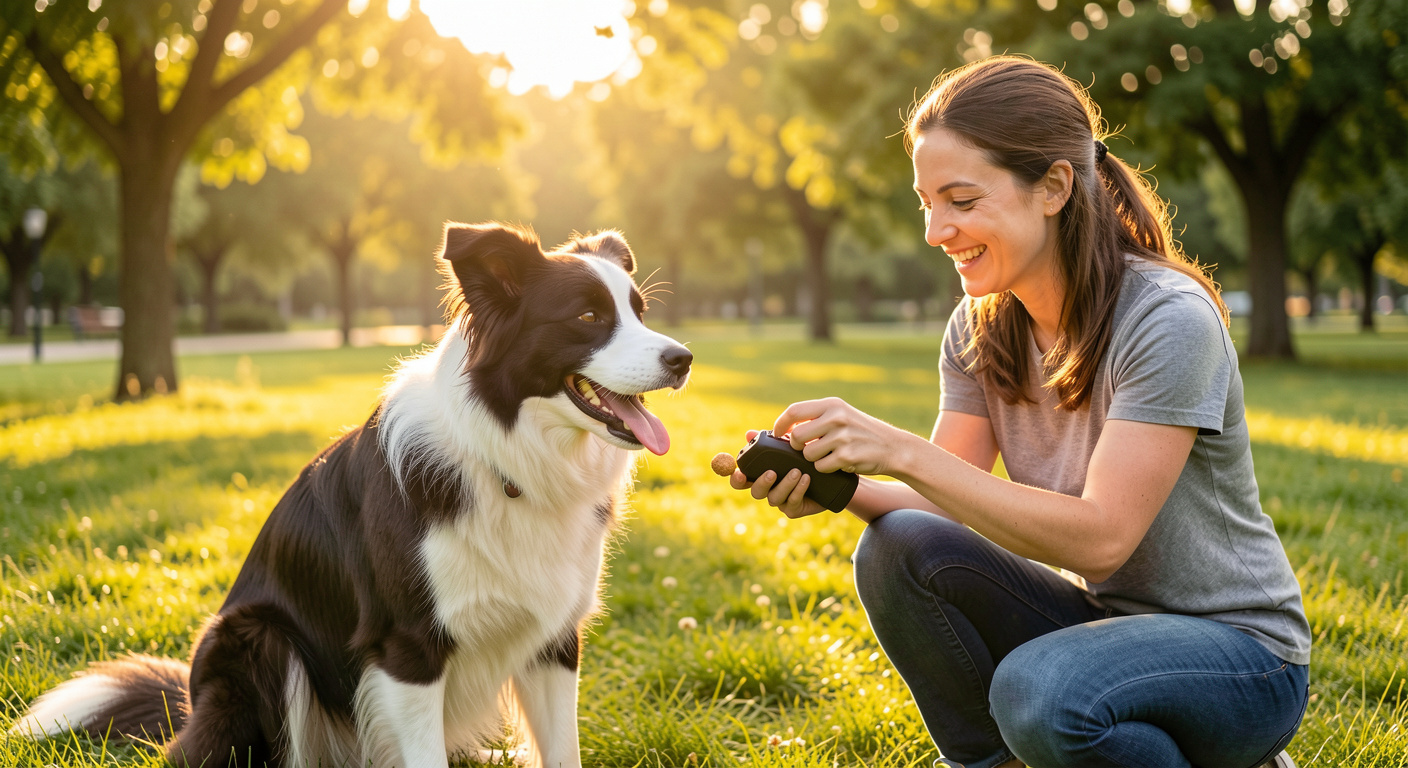
Capturing: Stand quietly with treats ready. When your dog naturally sits, mark (“yes!”) and treat. Repeat until they offer sits unprompted, then add the verbal cue. Luring: Hold a treat at nose level. Slowly lift it up and back , the nose follows, the bottom lowers. Mark and treat. After 5, 10 reps, transition to an empty hand signal, then add the verbal cue.
2. Stay
Teach a release word first (“OK!” or “free!”). Ask for a sit, treat. Wait 1 second, treat again, then release. Gradually increase wait time. Add distance one step at a time , always return to the dog to deliver the treat in the stay position. Never call the dog out of a stay.
3. Come (Recall)
Recall should be the most rewarding thing in your dog’s life. Start indoors: call cheerfully, treat immediately. Drop a treat near your feet; after eating, call and reward. Progress to outdoors on a 15, 30 ft long line. Never punish a dog for coming to you. Never call to end fun.
4. Leave It
Fist game: Hold a treat in your closed fist. Let the dog sniff and paw. The instant they pause or pull away, mark and treat from your other hand. Progress through open palm, floor with hand cover, floor uncovered, and real-world practice.
5. Drop It
Give your dog a toy. Hold a high-value treat near their nose. When they release, mark and treat. Add the cue “drop it” while presenting the treat. Fade the visible treat. Never pull an item from a dog’s mouth. For emergencies, scatter high-value treats on the ground as a trade.
6. Loose Leash Walking
Use a front-clip harness and 4, 6 ft leash. Choose a consistent side. Step, stop, treat at your pant seam. Gradually increase steps. If the dog pulls, stop , don’t yank. Teach a “go sniff” release for relaxed decompression walks.
7. Place / Bed
Toss treats onto a mat to build positive association. Shape: reward one paw on, then two, then all four, then lying down. Add the cue “place” or “bed.” Gradually increase distance and duration with distractions. Use your release word to end.
8. Wait at Doors
Approach a closed door with your dog on leash. Ask for a sit. Slowly open the door; if the dog moves, close it. Repeat until they hold position with the door open. Add the cue “wait.” Release with “OK” or “let’s go.”
Puppy Training Timeline: 8 Weeks to 1 Year
8 Weeks
Focus: trust, safety, routine. Name recognition, sit with luring, house training (every 30, 60 min when awake), crate introduction (feed meals inside), body handling (touch paws, ears, mouth while treating), socialization begins. Do not expect: bladder control, long crate stays, or reliable commands.
8, 16 Weeks: Critical Socialization Window
This window closes by ~16 weeks. The puppy’s brain absorbs what is safe vs. scary. Prioritize socialization over formal obedience. Positive exposures with treats. Crate training progression, continued house training, leash introduction indoors, bite inhibition.
By 6 Months
Working on: polite play with soft mouth and “drop it,” mostly reliable house training, comfort being alone, enthusiastic recall, impulse control, all basic cues in progress. Adolescence (6, 18 months) brings hormonal changes , trained behaviors may temporarily regress. This is normal. Stay consistent and positive.
By 1 Year
Mastery of foundation behaviors: reliable sit/down/stay with duration and distance, recall with distractions, loose-leash walking as default, reliable “drop it” and “leave it” in real situations, polite greeting behavior.
Common Behavior Problems Solved
Potty Training
Schedule is everything. Take puppy out first thing in morning, after every meal, after naps, after play, before bedtime, and every 30, 60 minutes when awake. Rule of thumb: a puppy can hold their bladder for roughly age in months plus one hours. Always use the same outdoor spot. Reward within 1, 2 seconds. No punishment for accidents. Clean with enzymatic cleaner and move on.
Crate Training
The crate is a den, not a prison. Never use for punishment. Feed all meals inside. Toss treats in; let the dog explore voluntarily. Build duration gradually. Follow the 2:1 rule: for every 2 hours in, at least 1 hour out. Puppy limits: max 3, 4 hours under 6 months; adult dogs up to 6 hours daytime.
Leash Pulling
Three solutions combined: (A) Be a tree , stop when leash tightens, wait for slack, then continue. (B) Change direction , turn and walk opposite way, reward when they catch up. (C) Reward the position , proactively treat for walking beside you. Use a front-clip harness. Teach a “go sniff” release.
Jumping on People
Dogs jump because it gets attention , even negative attention reinforces it. Ignore jumping completely: turn your back, cross your arms, say nothing. When all four paws hit the floor, turn back with calm attention and treats. Consistency from every single person is non-negotiable.
Excessive Barking
Identify the cause first. Alert barking: thank the dog (“thank you, I see it”), then redirect. Demand barking: ignore completely, reward silence. Boredom barking: increase exercise and mental enrichment. Fear/anxiety barking: address underlying fear through desensitization , consult a professional for severe cases.
Separation Anxiety
This is a panic disorder, not misbehavior. Symptoms: elimination only when alone, persistent barking/howling, destructive chewing at exit points, pacing, escape attempts. For mild cases: counterconditioning with a food-stuffed frozen KONG. For moderate/severe: systematic desensitization with a certified separation anxiety trainer. Never punish destruction discovered after returning home.
Resource Guarding
Guarding is natural, not “dominance.” A 2024 study found 62% of cases worsened after confrontational methods. Use the Trade-Up Protocol: exchange the taken item for something better. Prevention: hand-feed puppies, drop high-value treats into their bowl while they eat. For severe cases involving biting, hire a positive-reinforcement professional.
Digging
Redirect, don’t fight instinct: give a designated digging area like a sandbox, bury toys and treats, reward digging there. Increase exercise and enrichment. Never punish , it doesn’t teach an alternative.
Chewing
Puppy chewing is normal exploration and teething (peaks 4, 6 months). Manage by puppy-proofing. Redirect with appropriate toys, praising heavily. Provide variety (KONGs, nylon bones, bully sticks, frozen washcloths). Rotate toys for novelty.
Socialization Checklist
The critical period runs from 3 to 16 weeks. The golden rule: pair every new exposure with high-value treats. If the puppy seems frightened and won’t take treats, increase distance or reduce intensity.
People
- Adult men and women of different ethnicities
- Tall men; men with beards or deep voices
- People wearing hats, sunglasses, backpacks
- People using canes, walkers, wheelchairs
- Teenagers; toddlers; elderly people
- People running, jogging, bicycling, skateboarding
- People in uniforms (mail carriers, delivery drivers)
Other Animals
- Healthy vaccinated puppies and friendly adult dogs
- Cats (supervised); small animals; farm animals (at safe distance)
Surfaces & Sounds
- Carpet, hardwood, tile, stairs, grass, gravel, sand, concrete
- Sirens, car horns, motorcycles, thunderstorms, fireworks (low volume recordings)
- Doorbells, vacuum, blender, hair dryer, construction noise
Handling & Body Exams
- Checking ears, mouth, gums; touching paws and nails
- Grabbing collar gently; hugging and cradling
- Wiping with towel; brushing coat; bathing
Training Tools Compared
Recommended
- Front-Clip Harness: The recommended tool for most dogs. Safe for trachea and spine. Naturally turns dog back toward you without pain.
- Martingale Collar: For escape-artist dogs and sighthounds. Tightens to a snug , not choking , fit.
- Flat Collar: For ID tags and dogs that never pull.
- Long Line (15, 50 ft): For recall proofing and decompression walks. Always pair with a harness.
Tools to Avoid
| Tool | Why It’s Harmful |
|---|---|
| Choke Chains | Causes pain, choking, tracheal damage. |
| Prong/Pinch Collars | Metal prongs pinch neck; causes pain and fear. Banned in several countries. |
| Shock/E-Collars | Delivers electric shock; linked to increased anxiety and aggression. |
| Retractable Leashes | Thin cord can cause severe friction burns or strangulation. Zero control in emergencies. |
When to Hire a Professional
The dog training industry is unregulated , anyone can call themselves a trainer. Look for these credentials:
- CPDT-KA: Gold standard minimum credential. 300+ hours experience + science-based exam.
- KPA CTP: Karen Pryor Academy , 6-month positive reinforcement program.
- IAABC (ADT/CDBC): Case-study assessments evaluated by experts.
- CBCC-KA: Advanced credential for complex behavior cases.
Red Flags
- Uses “dominance” or “alpha” language
- Guarantees results
- Relies on punishment-based tools (shock, prong, choke)
- Won’t let you observe a session
- Uses fear, intimidation, or pain
- Promises quick fixes for serious issues
Green Flags
- Uses rewards as primary method
- Explains the “why” behind techniques
- Continues education and stays current with science
- Encourages you to observe a session
- Creates a calm, positive environment
- Provides follow-up support
Training Formats & Costs (2026)
| Format | Best For | Approx Cost |
|---|---|---|
| Group Classes | Basic obedience, socialization, puppies | $100, 300 / 6, 8 weeks |
| Private Sessions | Behavior issues, specific goals | $75, 200 / hour |
| Board & Train | Intensive training | $1,000, 3,000+ / week |
| Virtual Training | Minor issues, remote areas | $50, 100 / session |
Your Training Journey Starts Here
Every dog learns at their own pace. Setbacks aren’t failures , they’re information. The goal isn’t perfection; it’s a relationship built on trust, communication, and mutual respect. Be the patient, consistent teacher your dog deserves.
Explore Our Training Resources →