What the Science Actually Says About Your Dog’s Food
The best dog food brands aren’t the ones with the prettiest bags or loudest Instagram ads. They’re the brands that employ board-certified veterinary nutritionists, own their manufacturing facilities, conduct AAFCO feeding trials, and publish peer-reviewed research. Five brands consistently meet WSAVA guidelines: Purina Pro Plan, Hill’s Science Diet, Royal Canin, Eukanuba, and Iams. Budget-friendly Iams starts at $1.20/day; fresh-food subscriptions like The Farmer’s Dog run $5–8/day. For most healthy dogs, a mid-range WSAVA-compliant kibble is the safest, most researched choice.
Words like “holistic,” “ancestral,” and “human-grade” have no legal definition in pet food. WSAVA and AAFCO set the real standards , learn what they actually mean.
A brand that employs veterinary nutritionists and manufactures in its own facilities is safer than a boutique brand co-packed at an unknown plant, regardless of the ingredient list.
Iams and Purina ONE meet WSAVA guidelines at $1.20–$2.00/day. Expensive ≠ better , the nutritional difference between budget WSAVA brands and $120 boutique bags is often negligible or even favors the budget brand.
- 5 brands meet WSAVA guidelines: Purina Pro Plan, Hill’s Science Diet, Royal Canin, Eukanuba, and Iams
- Iams is the most affordable WSAVA-compliant option at just $1.20/day for a 30 lb dog
- Grain-free diets linked to DCM heart disease in dogs , grain-inclusive is safer for most dogs
- “Holistic” and “human-grade” have no legal definition in pet food , look for AAFCO feeding trials
- Budget brand Iams offers comparable nutrition to $60/bag boutique brands with better research backing
The Standards That Actually Matter
Walk down any pet store aisle and you’ll see words like “holistic,” “natural,” “ancestral diet,” and “vet-approved” splashed across bags. Most of these terms are marketing , they have no legal definition in pet food. So how do you cut through the noise?
Two organizations set the real standards in dog food manufacturing: the Association of American Feed Control Officials (AAFCO) and the World Small Animal Veterinary Association (WSAVA). AAFCO establishes nutrient profiles that define minimum levels of protein, fat, vitamins, and minerals. Any food labeled “complete and balanced” must meet AAFCO profiles through either formulation or feeding trials.
WSAVA goes further. Its guidelines ask manufacturers to answer eight specific questions: Do you employ a full-time veterinary nutritionist? Who formulates your diets? Do you own your manufacturing facilities? What quality control measures do you use? Do you conduct feeding trials beyond AAFCO minimums? The brands that can answer all eight questions clearly and publicly are the ones veterinary nutritionists trust.
The five brands that currently meet WSAVA guidelines: Royal Canin, Hill’s Science Diet, Purina (Pro Plan and ONE lines), Eukanuba, and Iams. These brands employ board-certified veterinary nutritionists, own their manufacturing facilities, conduct rigorous feeding trials, and publish peer-reviewed research.
Understanding Dog Food Types
Dry Kibble
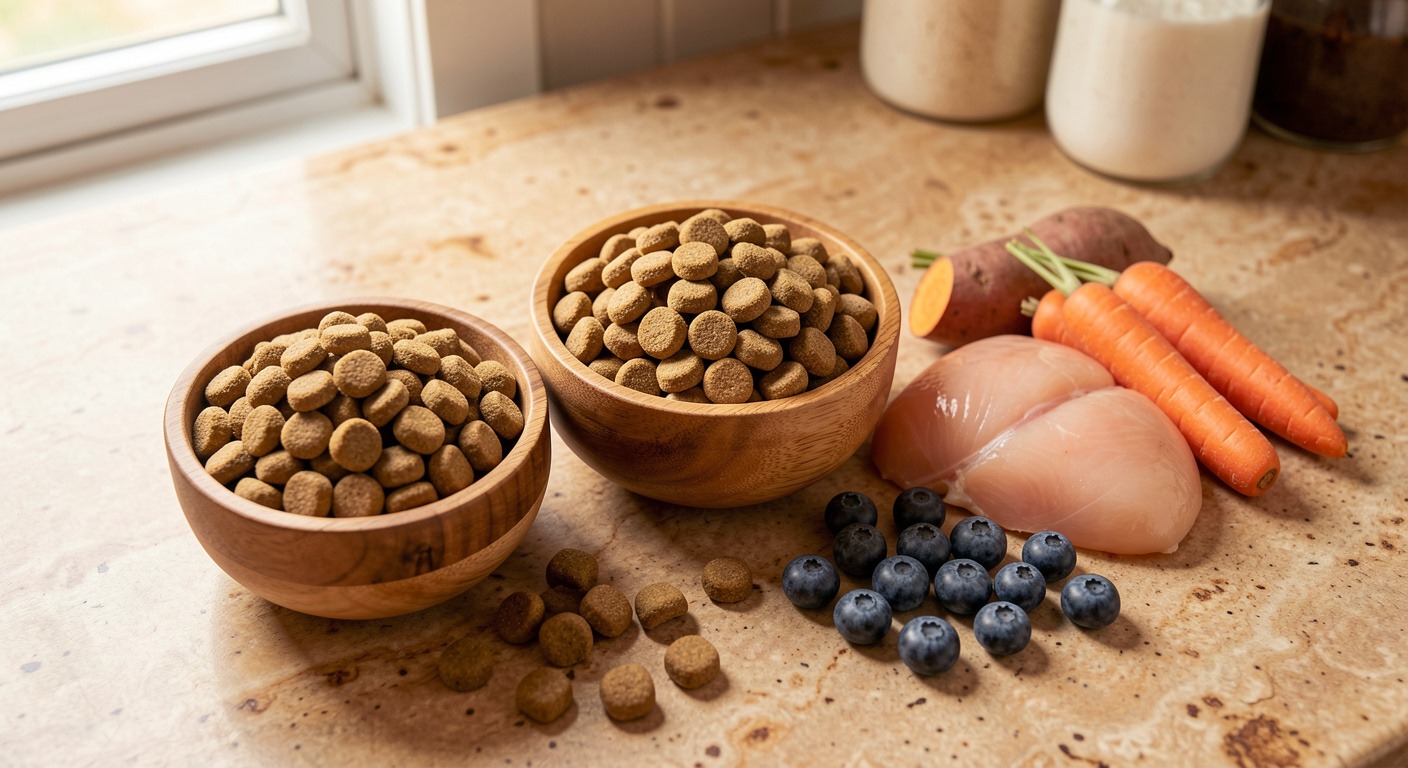
The most common format , affordable, shelf-stable, and convenient. High-quality kibble from WSAVA-compliant brands is nutritionally complete. The extrusion process has been studied for decades and is well understood. Kibble also provides dental benefits: the mechanical action of crunching helps reduce tartar buildup, though it’s not a substitute for brushing. Expect to pay $1.50–$4.50 per pound for premium kibble.
Wet / Canned Food
Higher moisture content (75–78% vs. 10–12% in kibble) makes wet food excellent for dogs who don’t drink enough water, have kidney concerns, or are picky eaters. It’s also highly palatable , useful for hiding medication. The trade-offs: more expensive per calorie, shorter shelf life once opened, and less dental benefit. Price: $2.50–$6.00 per can. Many owners feed a mix of wet and dry.
Fresh / Human-Grade Food
Brands like The Farmer’s Dog, Ollie, and Nom Nom cook meals from USDA-certified human-grade ingredients, then ship them frozen. These foods look like real food , you see the green beans, the chicken, the sweet potato. Fresh food is highly palatable and many owners report shinier coats and better digestion. The downsides: expensive ($5–$10/day for a medium dog), requires freezer space, and has a shorter track record of feeding trials compared to legacy brands.
Raw / BARF Diets
Raw feeding remains controversial in veterinary medicine. The AVMA, FDA, and CDC all discourage raw diets due to documented pathogen risks , to both dogs and the humans in the household. Studies have found Salmonella, Listeria, and E. coli in commercial raw products. While some owners swear by raw feeding, the scientific consensus from veterinary organizations leans heavily against it, especially in homes with children, elderly, or immunocompromised individuals.
Freeze-Dried and Dehydrated
A middle ground between raw and kibble. These foods are minimally processed and retain more nutrients than extruded kibble, but the dehydration or freeze-drying process reduces (though does not eliminate) pathogen risk compared to raw. Brands like Stella & Chewy’s and Primal lead this category. Price: $15–$35 per pound , among the most expensive formats.
Brand-by-Brand Breakdown
| Brand | Type | WSAVA? | Price/Day* | Best For |
|---|---|---|---|---|
| Purina Pro Plan | Kibble/Wet | ✅ Yes | $1.80–$3.00 | Active dogs, breed-specific formulas, proven track record |
| Hill’s Science Diet | Kibble/Wet | ✅ Yes | $2.00–$3.50 | Prescription-adjacent wellness, sensitive stomachs, puppies |
| Royal Canin | Kibble/Wet | ✅ Yes | $2.50–$4.00 | Breed-specific formulas, precise life-stage nutrition |
| Eukanuba | Kibble | ✅ Yes | $1.80–$3.00 | Sporting/working dogs, large breeds, performance |
| Iams | Kibble | ✅ Yes | $1.20–$2.00 | Budget-friendly WSAVA-compliant option |
| The Farmer’s Dog | Fresh | ⚠️ Partial | $4.00–$8.00 | Picky eaters, dogs who refuse kibble |
| Ollie | Fresh | ⚠️ Partial | $4.00–$7.00 | Fresh-food convenience, multiple protein options |
*Estimated daily cost for a 30 lb dog. Actual costs vary by formula and retailer.
How to Read a Dog Food Label
1. The AAFCO Statement
Find the small print on the back or side: “[Brand Name] is formulated to meet the nutritional levels established by the AAFCO Dog Food Nutrient Profiles for [life stage].” If it says “for intermittent or supplemental feeding only,” this is NOT a complete diet , it’s a topper or treat. If it mentions feeding trials, that’s a higher standard than formulation alone.
2. Named Protein Sources
“Chicken” is specific. “Poultry meal” and “meat by-products” are less specific but not inherently bad , by-products include organ meats that are actually more nutrient-dense than muscle meat. The real question is whether the manufacturer knows and controls their supply chain. A vague ingredient from a WSAVA-compliant manufacturer is safer than a specific ingredient from one that doesn’t employ a nutritionist.
3. Ingredient Splitting
Watch for this trick: listing “peas, pea protein, pea fiber, pea starch” separately so they appear further down the list, when combined they might outweigh the first ingredient. Ingredient splitting makes a grain-free food look meat-heavy when it’s actually legume-heavy , a concern given the FDA’s ongoing investigation into a link between grain-free diets and dilated cardiomyopathy (DCM).
The Grain-Free Question and DCM
In 2018, the FDA announced an investigation into a spike in dilated cardiomyopathy (DCM) cases in dogs eating grain-free diets , particularly those heavy in peas, lentils, chickpeas, and potatoes. Breeds not genetically prone to DCM were developing it. The investigation remains open and has expanded to include thousands of cases.
The current veterinary consensus: unless your dog has a diagnosed grain allergy (which is rare , most food allergies are to animal proteins, not grains), there is no proven benefit to grain-free diets. The potential risk of DCM, while not fully understood, outweighs any theoretical benefit for most dogs. Grain-inclusive diets from WSAVA-compliant brands are the safer default.
Do not switch a dog’s diet based on internet advice alone. If your dog is on a grain-free diet prescribed by a veterinary cardiologist or dermatologist, follow their guidance. For healthy dogs on grain-free diets chosen for philosophical reasons, discuss the DCM concern with your veterinarian at your next checkup.
Life Stage Matters
A Great Dane puppy and a 12-year-old Chihuahua have radically different nutritional needs. Feeding the wrong life stage formula can cause real harm.
Puppy Food (0–12 months, longer for large breeds)
Puppies need higher protein, fat, calcium, and phosphorus to support rapid growth. Large-breed puppies have an additional requirement: controlled calcium levels to prevent developmental orthopedic diseases like hip dysplasia. Always feed large-breed puppies a food specifically labeled for large-breed growth.
Adult Maintenance (1–7 years)
Most adult dogs thrive on a maintenance formula that meets AAFCO’s adult profile. Active dogs, working dogs, and pregnant/nursing dogs may need a performance or “all life stages” formula with higher caloric density.
Senior (7+ years, varies by breed)
Senior formulas typically feature moderate protein, lower calories, added glucosamine/chondroitin for joint health, and higher fiber for digestive health. Giant breeds are considered senior earlier; small breeds later. Talk to your vet , there’s no universal cutoff.
Budget Guide: Quality at Every Price
| Budget Tier | Per Day (30 lb dog) | Recommendations |
|---|---|---|
| 💵 Budget | $1.00–$1.80 | Iams ProActive Health, Purina ONE |
| 💵💵 Mid-Range | $1.80–$3.00 | Purina Pro Plan, Eukanuba, Hill’s Science Diet |
| 💵💵💵 Premium | $3.00–$4.50 | Royal Canin, Hill’s prescription diets |
| 💵💵💵💵 Fresh/Human-Grade | $4.50–$10.00 | The Farmer’s Dog, Ollie, Nom Nom |
Iams and Purina ONE meet WSAVA guidelines at roughly $1.20–$2.00/day for a medium dog. The nutritional difference between Iams and a boutique $60/bag grain-free food is often negligible or even favors the budget brand in terms of research backing.
5 Questions to Ask Before Switching Foods
- Does this brand employ at least one full-time, board-certified veterinary nutritionist? If they can’t name them, that’s a red flag.
- Do they manufacture in their own facilities? Co-packing isn’t automatically bad, but it reduces quality control transparency.
- Have they conducted AAFCO feeding trials , not just formulation? Feeding trials involve actual dogs eating the food for 6 months. Formulation means someone did math on a spreadsheet.
- What peer-reviewed research has this brand published? If the answer is “none,” ask why.
- Can my dog thrive on this food for years? Some diets are designed for short-term use or rotation. Make sure your daily driver is a complete and balanced maintenance formula.
Bottom Line
The best dog food brand is the one your dog thrives on, that’s backed by nutritional science, and that fits your budget. For most dogs, a WSAVA-compliant kibble from Purina Pro Plan, Hill’s Science Diet, or Royal Canin is the safest, most well-researched choice. Fresh food brands offer improved palatability and ingredient transparency but come with higher cost and less long-term research. Always transition foods gradually over 7–10 days to avoid digestive upset, and involve your veterinarian in major diet decisions , especially if your dog has a health condition.
Keep Reading

Still Not Sure Which Brand to Pick?
Our decision guide walks you through a simple 5-question test to evaluate any brand for YOUR specific dog. No top-10 lists , just a framework you can use for life.
Read the Decision Guide →