The Gear Guide Every Dog Parent Needs Before the Next Walk
For walks, a harness is the safer choice for most dogs. It distributes pressure across the chest instead of concentrating it on the throat, which protects the trachea, thyroid, and cervical spine. A flat collar is essential for holding ID tags and works fine for calm, well-trained dogs on loose-leash walks. But if your dog pulls, lunges, or has a delicate neck (small breeds, toy breeds, flat-faced breeds), a collar with a leash attached can cause serious injury. The best setup: a well-fitted flat collar for ID tags plus a harness for every walk. The fit matters more than the price tag: you should be able to slip one finger (small dogs) or two fingers (large dogs) between the gear and your dog’s skin.
Distributes pressure across the chest, not the throat. Safer for pullers, small breeds, and flat-faced dogs.
Every dog needs a collar with ID tags. For calm walkers, a flat collar works fine. But it should not be your primary walking tool.
An ill-fitting harness chafes or lets your dog escape. An ill-fitting collar can slip off or damage the trachea.
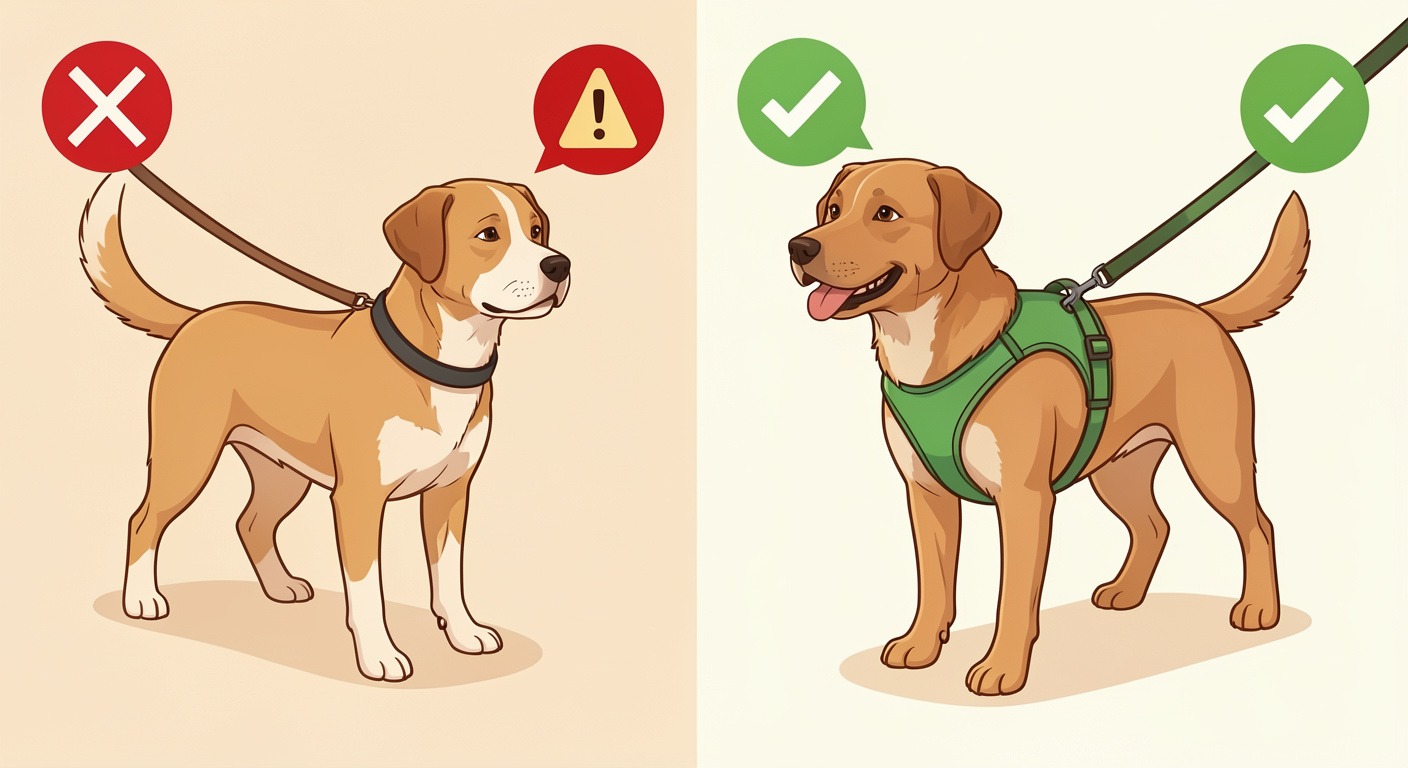
Dog Harness vs Collar: The Main Difference
The core difference is where the pressure from the leash goes. A collar concentrates all the force of a pull, lunge, or sudden stop on a small ring of tissue around your dog’s throat, the trachea, thyroid gland, esophagus, and cervical vertebrae. A harness spreads that same force across the chest, shoulders, and back, areas built to absorb it. This is not a subtle difference. Even a 20-pound dog pulling on a collar can generate enough tracheal pressure to cause damage over time. For a 70-pound dog that lunges at a squirrel, the force on a collar is comparable to a sharp blow to the throat.
The risks of collar pressure are well documented. The American Veterinary Society of Animal Behavior (AVSAB) advises against walking tools that place pressure on the neck, and the American Animal Hospital Association (AAHA) recommends harnesses over collars for dogs with respiratory or tracheal concerns. The American Kennel Club (AKC) and VCA Animal Hospitals both provide guidance on choosing walking equipment based on breed and health status.
Puptify provides general education, not veterinary advice. If your dog has a history of tracheal collapse, breathing problems, neck injuries, or cervical spine issues, consult your veterinarian before choosing walking equipment. For reactivity or severe pulling, work with a CCPDT-certified force-free trainer or an IAABC certified behavior consultant. The Center for Pet Safety provides independent crash-test ratings for travel harnesses.
When to Use a Dog Harness
A harness is the right choice for walks, hikes, training sessions, and any activity where a leash is attached. It is the safer walking tool for the vast majority of dogs for these reasons:
- Dogs who pull or lunge. A harness redirects force to the chest instead of the throat. This protects the trachea while giving you more control.
- Small breeds and toy breeds. Chihuahuas, Yorkies, Pomeranians, and similar dogs have delicate tracheas that can collapse from collar pressure, a condition called tracheal collapse that often requires lifelong management.
- Brachycephalic (flat-faced) breeds. French Bulldogs, Pugs, Boxers, and Boston Terriers already have compromised airways. Any neck pressure makes breathing harder and can trigger respiratory distress.
- Dogs with narrow heads. Greyhounds, Whippets, and Salukis can slip out of flat collars. A well-fitted harness, possibly paired with a martingale collar for ID, prevents escape.
- Dogs with neck injuries, collapsing trachea, or cervical spine issues. Harnesses eliminate neck pressure entirely.
- Puppies. Their necks are still developing. Start harness training early so they associate walks with comfort, not pressure.
When to Use a Dog Collar
The flat collar still has an essential role: holding identification. Every dog should wear a collar with up-to-date ID tags at all times, or at minimum whenever outside. Even if you walk on a harness, the collar stays on for identification.
Collars also work well for specific situations:
- Calm, well-trained dogs who walk on a loose leash without pulling
- Dogs whose necks are wider than their heads, reducing escape risk from a flat collar
- Quick potty breaks when you do not want to wrangle a harness
- Holding ID and rabies tags, this is non-negotiable regardless of what walking gear you use
A dog that never pulls, has no respiratory issues, and walks politely on a loose leash can safely use a flat collar for walks. But that describes a minority of pet dogs. If you are unsure, default to a harness for walking and keep the collar for tags.
Always walk small and toy breeds on a harness. Their tracheas are too delicate for collar pressure, even from light pulling.
If your dog pulls at all, use a harness. Every pull on a collar is a micro-injury to the throat that adds up over months and years.
At home, remove both harness and collar to prevent chafing, matting, and the rare but serious risk of collar entanglement.
Harness vs Collar Comparison Table
Seven common gear types compared side by side. Use this table to match the right tool to your dog’s specific needs:
| Gear Type | Best For | Pros | Cons | Safety Note |
|---|---|---|---|---|
| Flat Collar | ID tags, calm walkers | Lightweight, simple, always on for identification | All pressure on throat; dangerous for pullers, small dogs, flat-faced breeds | Remove for walks if your dog pulls. Never attach a leash to a collar on a small or brachycephalic dog. |
| Martingale Collar | Sighthounds, escape artists | Tightens just enough to prevent backing out; has a fixed stopping point so it never chokes | Not a pulling deterrent; incorrect sizing can still allow escape | Test the tightened fit: two fingers must still slide underneath. Not a training tool for pulling. |
| Back-Clip Harness | Small dogs, calm walkers | Simple, comfortable, easy to put on; no pulling deterrent | Can encourage pulling in some dogs (sled-dog effect); gives the dog more pulling power | Avoid for strong pullers. The back attachment point gives your dog mechanical advantage. |
| Front-Clip Harness | Dogs who pull on leash | Redirects forward momentum sideways when the dog pulls; gentle steering without pain | Poor fit can restrict shoulder movement; some designs twist sideways under heavy pulling | Look for Y-shaped chest pieces that leave the shoulder joint free. Pair with training, not as a standalone fix. |
| Dual-Clip Harness | Versatility seekers | Front clip for training walks, back clip for relaxed strolls; best of both worlds | Slightly more expensive; more straps to adjust | Switch clips based on the walk: front for crowded streets and training, back for quiet trails and sniff walks. |
| Step-In Harness | Small dogs, dogs who dislike overhead harnesses | Dog steps in, clips on top; less intimidating than overhead styles | Can be escape-prone on dogs with narrow bodies; less secure than wrap-around designs | Always check the belly strap tightness. A loose step-in is easy to back out of. |
| Head Halter | Large, strong pullers; reactive dogs under professional guidance | Works like a horse halter, where the head goes, the body follows; gives steering control without force | Requires slow conditioning over days or weeks; many dogs dislike it initially; can injure the neck if jerked | Never yank a head halter. Introduce with treats over several sessions. Not a muzzle, your dog can still pant, drink, and take treats. |
Best Option by Dog Type
Every dog is different. This table matches common dog profiles to the safest, most effective walking gear:
| Dog Type | Best Option | Why | What to Avoid |
|---|---|---|---|
| Puppy | Y-shaped front-clip harness + flat collar for ID | Developing trachea needs protection; start positive harness association early | Walking on collar only; retractable leashes; heavy, bulky harnesses |
| Small Dog (under 20 lbs) | Back-clip or step-in harness + flat collar for ID | Tracheal collapse risk is high; harness eliminates throat pressure entirely | Any collar with leash attached for walks; choke chains; prong collars |
| Toy Breed | Soft, padded step-in harness + flat collar for ID | Extremely delicate tracheas; lightweight harness prevents pressure injuries | Heavy hardware; thick straps that overwhelm the dog’s frame; collar walking |
| Large, Strong Dog | Dual-clip harness or front-clip harness + head halter for management during training | You need mechanical advantage without harming the dog; dual-clip gives options | Flat collar for walks; back-clip only (amplifies pulling strength); retractable leashes |
| Dog Who Pulls | Front-clip Y-shaped harness + 4-6 ft leash | Redirects pulling momentum sideways; allows training without neck damage | Collar walking; prong or choke collars; harnesses that tighten under the arms |
| Reactive Dog | Front-clip harness plus head halter (conditioned slowly) under professional guidance | Combines body control with head steering for safety during reactions | Collar-only walking; aversive tools (increase fear); any gear introduced without conditioning |
| Brachycephalic (Flat-Faced) Breed | Y-shaped front-clip harness + flat collar for ID | Already compromised airways; any neck pressure risks respiratory distress | Any collar with leash attached; head halters (can restrict already-limited nasal breathing); back-clip harnesses that ride up on the throat |
| Sighthound / Escape Artist | Martingale collar for ID + well-fitted harness for walks | Narrow heads slip out of flat collars; martingale prevents escape without choking; harness provides walking safety | Flat collar only; loose harnesses; step-in harnesses (easy to back out of) |
| Senior Dog | Padded, easy-on harness (step-in or overhead with wide openings) + flat collar for ID | May have arthritis, vision loss, or neck sensitivity; comfort and ease of use are priorities | Snug overhead harnesses that require leg lifting; heavy, multi-strap designs; collar for walks |
| Dog with Neck or Spine Issues | Vet-recommended harness; often a padded Y-shaped or vest style | Collar pressure is contraindicated for cervical spine problems, IVDD, tracheal collapse, and thyroid conditions | Any collar with leash attached; head halters (can torque the neck); harnesses that ride up on the throat |
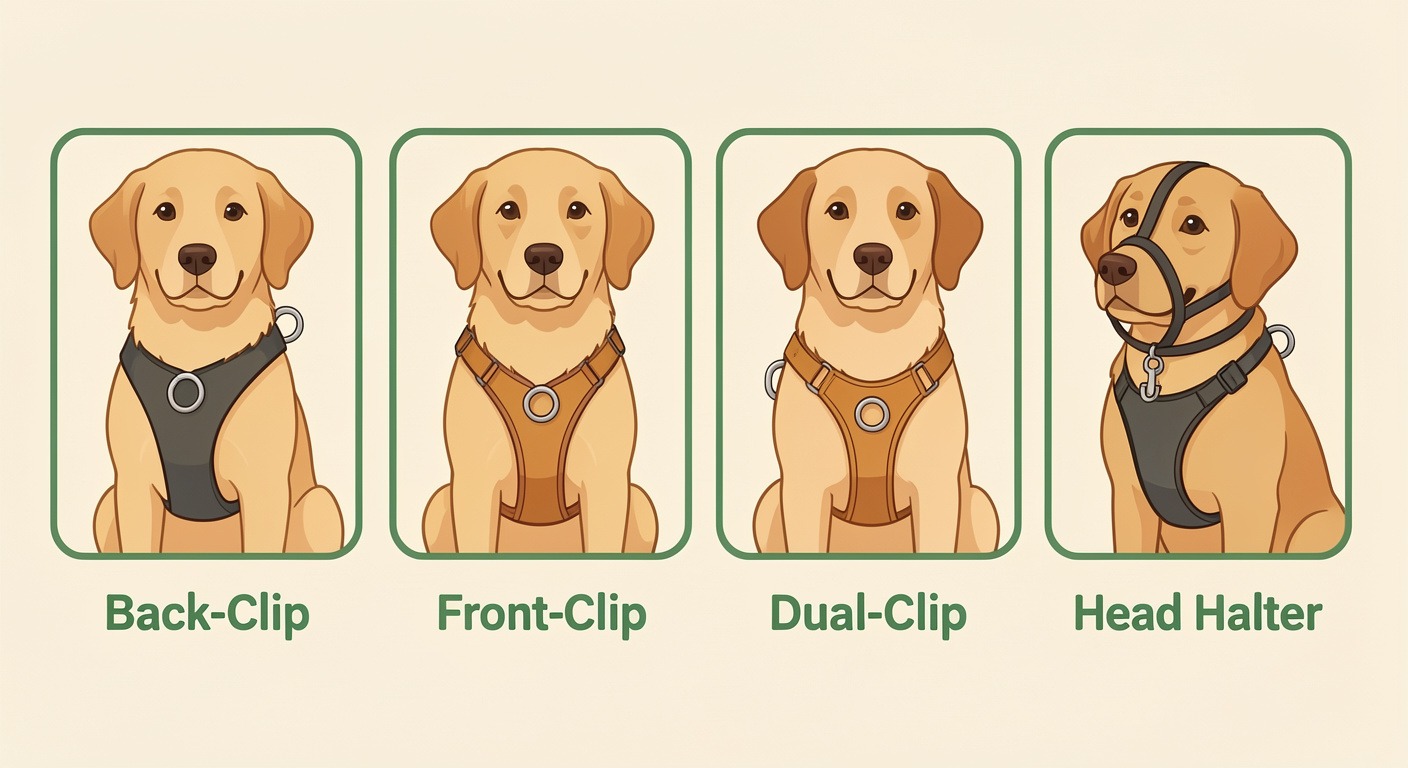
The 4 Main Types of Dog Harnesses
Not all harnesses work the same way. The clip location determines how the harness manages pulling and pressure:
Back-Clip Harness
The leash attaches to a D-ring on the dog’s back. This is the simplest, most common design. It is comfortable, easy to put on, and works well for dogs who already walk politely. The downside: back-clip harnesses give your dog mechanical advantage for pulling, which is why sled dogs wear back-clip harnesses. If your dog pulls, this style can make it worse. Best for small dogs, calm walkers, and short-haired dogs prone to chafing from front-clip designs.
Front-Clip Harness (No-Pull)
The leash attaches to a ring on the chest, over the breastbone. When your dog pulls forward, the harness gently redirects them sideways, toward you, reducing their forward leverage without causing pain. This is the most recommended style by force-free trainers for dogs learning loose-leash walking. Look for a Y-shaped chest piece that does not restrict shoulder movement. The Freedom Harness (2 Hounds Design) and Balance Harness (Blue-9) are well-regarded examples.
Dual-Clip Harness
Has attachment points on both the chest and the back. Use the front clip for training walks and crowded areas, and the back clip for relaxed sniff walks. A double-ended leash (connected to both front and back) gives you even more control for strong pullers. Examples: Ruffwear Front Range, Freedom Harness.
Step-In Harness
The dog steps into two loops and the harness clips on top of the back. This style is ideal for small dogs, dogs who dislike things going over their head, and seniors with limited mobility. The fit must be secure: a loose step-in harness is one of the easiest designs for a dog to back out of, especially dogs with narrow chests. Popular examples: Puppia Soft Harness, Gooby Comfort X.
| Harness Type | Clip Location | Best For | Safety Note |
|---|---|---|---|
| Back-Clip | Top of back | Small dogs, calm walkers | Not for pullers; gives the dog pulling leverage |
| Front-Clip | Chest / breastbone | Dogs who pull; training walks | Must not restrict shoulder movement; look for Y-shaped chest |
| Dual-Clip | Both front and back | Versatile: front for training, back for relaxed walks | Switch clips based on the walk context |
| Step-In | Top of back (clips there) | Small dogs; dogs who dislike overhead harnesses | Check belly strap tightness; narrow dogs can back out |
| Head Halter | Under chin | Strong pullers; reactive dogs (with professional guidance) | Requires slow conditioning; never yank the leash; not a muzzle |
What About Martingale Collars?
A martingale collar (also called a limited-slip collar) has a smaller loop that tightens when tension is applied, but with a fixed stopping point so it never fully closes on the neck. This makes it fundamentally different from a choke chain, which has no stopping point and can continue tightening indefinitely.
What martingales are for: preventing escape. Breeds with narrow heads (Greyhounds, Whippets, Salukis, Italian Greyhounds, and many sighthound mixes) can slip out of flat collars because their heads are smaller than their necks. The martingale tightens just enough to prevent backing out, but the stopper ensures it never chokes.
What martingales are not for: training. A martingale collar is not a pulling deterrent and should not be used as a training tool. It is an escape-prevention tool for identification purposes. If your sighthound pulls on walks, use a harness for the leash and keep the martingale for ID tags.
Fit check: When the martingale is tightened fully, you should still be able to slip two fingers between the collar and your dog’s neck. If it tightens more than that, the collar is too small. The wider loop should rest high on the neck, just behind the ears, which is the narrowest point and most effective position for preventing escape.
Martingale = escape prevention for ID. Harness = safe walking. If your dog has a narrow head, use both. Never walk any dog on a martingale collar alone if they pull, the stopping point prevents choking but pressure still concentrates on the throat.
Tools to Avoid: Choke, Prong, and Shock Collars
Not all dog gear is safe. Some products marketed as training or walking tools cause pain, fear, and physical injury. Leading veterinary and behavior organizations advise against them. Here are the tools to avoid and why:
- Choke chains (chain slip collars). These tighten without limit when pulled. They can cause tracheal damage, esophageal injury, increased intraocular pressure (dangerous for dogs with eye conditions), and nerve damage to the neck. The AVSAB and AAHA both recommend against them.
- Prong (pinch) collars. Metal prongs dig into the dog’s neck when tension is applied. They may temporarily suppress pulling through pain, but they do not teach the dog what to do instead. Risks include tracheal puncture, skin wounds, and behavioral fallout such as increased fear, anxiety, and redirected aggression.
- Shock collars (e-collars, electronic collars). These deliver an electric shock to the dog’s neck. Even when marketed as a “tap,” “stim,” or “vibration,” they rely on punishment to suppress behavior. Research links shock collars to increased stress, fear, and aggression. They are banned or restricted in several countries.
- Slip leads (without a stopper). A combined collar and leash that tightens under tension. Without a fixed stopping point like a martingale, these can choke the dog. They are acceptable for quick handling in shelter or veterinary settings with a stopper, but not as a primary walking tool.
- Retractable leashes during training. Retractable leashes create constant tension, which teaches the dog that leash pressure equals forward movement. They make it impossible for a dog to learn what a loose leash feels like. The thin cord can also cause burns, cuts, and entanglement. Reserve retractables for open, low-distraction areas with dogs who already walk politely.
- Shoulder-restricting harnesses. Some “no-pull” harnesses tighten across the shoulder joint or have a horizontal chest strap that sits directly across the shoulder blades. Over time, this can alter gait and cause orthopedic issues. Look for Y-shaped chest pieces that leave the shoulder joint free.
- Using a collar as the primary walking tool for strong pullers. Every pull on a collar compresses the trachea, thyroid, and cervical vertebrae. A single sharp lunge can cause injury; years of daily pulling compound the damage.
- Loose, poorly fitted harnesses. A harness that is too loose lets dogs escape. A harness where you cannot fit fingers under the straps is too tight and causes chafing. Always do the two-finger fit test.
- Leaving a harness on all day. Harnesses can cause chafing, matting, and skin irritation when left on continuously. Remove the harness after walks. The collar with ID tags can stay on, but even collars should be removed at night or during unsupervised home time to prevent entanglement risks.
The AVSAB position statement on humane training recommends reward-based methods over aversive tools. The Fear Free certification program, used by thousands of veterinary practices, teaches that training should be pain-free and fear-free. The Certification Council for Professional Dog Trainers (CCPDT) and the International Association of Animal Behavior Consultants (IAABC) both maintain directories of certified professionals who use force-free methods. For car safety, the Center for Pet Safety conducts independent crash testing and publishes ratings for travel harnesses and carriers.
How to Fit a Dog Harness Correctly
A poorly fitted harness is uncomfortable at best and dangerous at worst. Dogs slip out of loose harnesses and into traffic. Tight harnesses chafe, restrict breathing, and cause skin damage. Here is the correct fit procedure and the most common mistakes:
Harness Fit Checklist:
- Put the harness on and adjust all straps before clipping the leash.
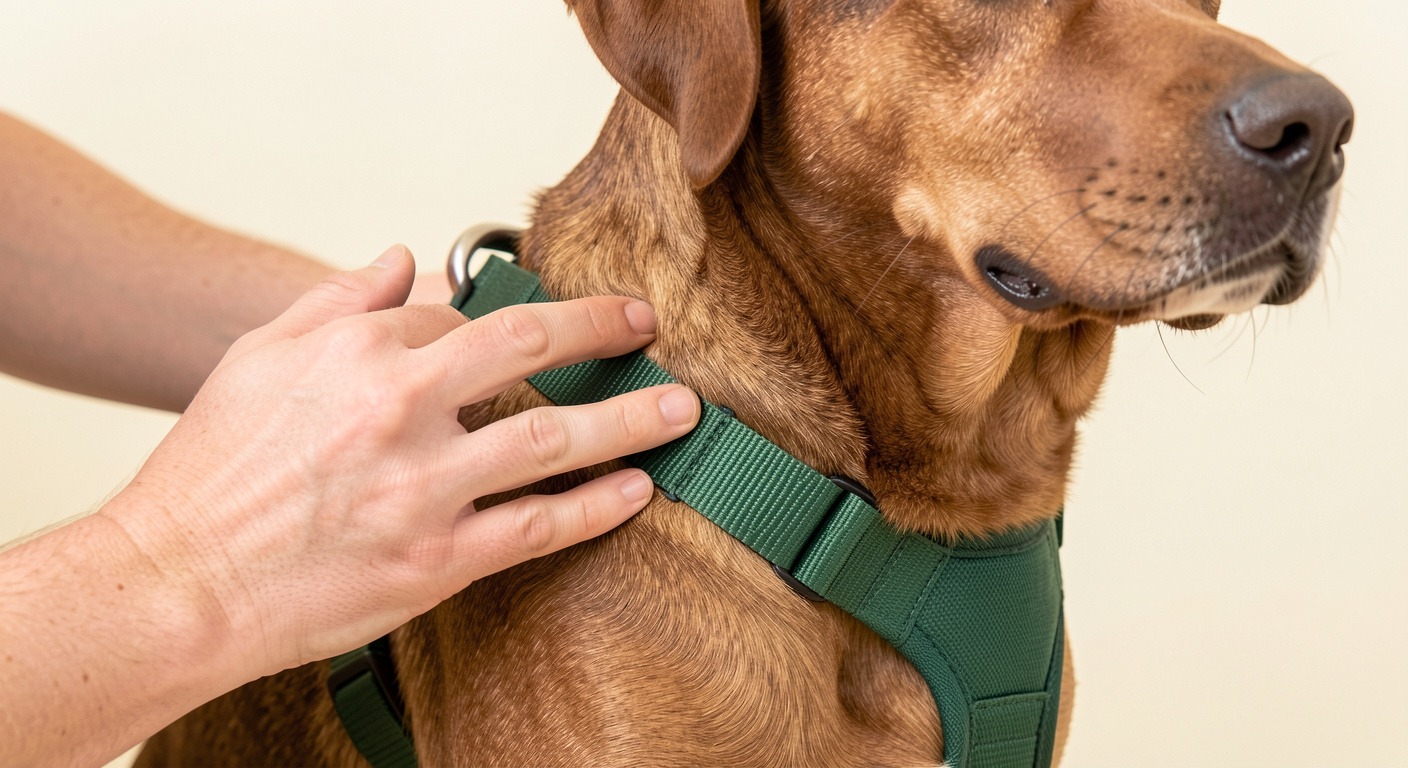
- Slide one finger (small dogs) or two fingers (large dogs) between the harness and your dog’s body at the neck, chest, and belly straps. It should feel snug but not tight.
- Try to slip the harness over your dog’s head. If it comes off, it is too loose.
- Check under the armpits. Straps that sit in the armpit cause chafing. They should sit about one inch behind the front legs.
- Check the shoulder area. The chest strap should form a Y-shape and not restrict the shoulder joint. Watch your dog walk: if their stride looks shorter or their front legs seem to catch on the strap, the harness is too restrictive.
- Watch for rub marks, hair loss, or redness after walks. These signal poor fit or material sensitivity.
- Check the fit weekly. Puppies grow fast. Adult dogs gain and lose weight. A harness that fit last month may not fit today.
8 Common Harness Fit Mistakes:
- Too loose. The dog can back out or slip a leg through. This is the most dangerous mistake, especially near roads.
- Too tight. Straps dig into the skin, restrict breathing, or limit shoulder movement. You should fit two fingers (large dogs) or one finger (small dogs) under every strap.
- Straps in the armpits. Friction here causes painful chafing that can become raw and infected. The belly strap should sit about an inch behind the front legs.
- Overhead harness forced on a fearful dog. Some dogs panic when something goes over their head. Use a step-in harness or a harness that clips around the neck instead. Never force it.
- Horizontal chest strap across the shoulder joint. Straps that run straight across the shoulder blades restrict natural gait. Over months and years, this can cause orthopedic issues. Look for Y-shaped chest pieces.
- Not checking after weight changes. A harness that fit your 8-week-old puppy will not fit your 4-month-old puppy. Recheck every week for growing dogs, monthly for adults.
- Using the wrong size entirely. Harness sizes vary dramatically between brands. Always measure your dog’s chest girth and neck before buying, and check the brand’s size chart. Small from one brand may be XS from another.
- Leaving the harness on unsupervised. A harness left on at home can snag on furniture, crate bars, or another dog’s teeth during play. Remove it after walks.
How to Fit a Dog Collar Correctly
Even a simple flat collar needs to be fitted correctly. Too loose and it slips off. Too tight and it restricts breathing, causes discomfort, or damages the trachea.
Collar Fit Checklist:
- Buckle the collar around the dog’s neck at the position where it will sit, high on the neck, just behind the ears.
- Slide one finger (small dogs) or two fingers (large dogs) between the collar and the neck. It should slide through with light resistance.
- Try to slip the collar over the dog’s head. For escape-prone breeds (sighthounds), it should not come off; if it does, switch to a martingale collar.
- Visually check: the collar should not indent the skin or fur, and the dog should swallow, pant, and move their head freely.
- Check the collar weekly. Puppies grow fast, and adult dogs gain or lose weight. A collar that fit three months ago may now be too tight.
7 Common Collar Fit Mistakes:
- Too tight. Collar digs into the neck, restricts breathing, and can damage the trachea over time. This is especially dangerous for small dogs.
- Too loose. The collar slips over the dog’s head. This is an escape and identification failure. If the dog is lost without tags, the collar did not do its job.
- Worn too low on the neck. A collar sitting at the base of the neck is easier to slip out of and gives the dog more pulling power. Position collars high, just behind the ears.
- Not checking as the dog grows. A puppy can outgrow a collar in weeks. Check weekly for puppies, monthly for adults.
- Using a collar with frayed stitching or a failing buckle. A collar that breaks on a walk is a lost-dog emergency. Replace collars at the first sign of wear.
- Leaving a collar on during crate time or rough play. Collars can snag on crate bars, furniture, or another dog’s jaw during play, causing strangulation. Remove collars during crate time and rough play.
- Using a martingale without a stopper check. Confirm the martingale’s stopping point limits how far it tightens. When fully tightened, two fingers must still fit underneath.
Remove your dog’s collar (and harness) during crate time, rough play with other dogs, and when left unsupervised at home. Collar strangulation during play is a rare but documented cause of death in dogs. A breakaway collar designed specifically for safety can reduce this risk for dogs who must wear a collar unsupervised. Your dog should still wear ID at all times outside the home: put the collar on before leaving and remove it when you return.
Can Dogs Wear a Harness All Day?
No. A harness should go on for walks and come off when you get home. There are several reasons for this:
- Chafing and skin irritation. Even a well-fitted harness rubs against the skin with movement. Over hours, this causes friction burns, especially in the armpit area and behind the front legs.
- Matting and coat damage. For dogs with medium to long coats, harness straps cause matting that can tighten to the skin and require shaving to remove.
- Moisture and skin infections. A harness traps moisture against the skin, especially in warm weather or after a wet walk. This creates an environment where bacteria and yeast thrive.
- Safety. A harness left on during unsupervised play or crate time can snag on objects, other dogs’ teeth, or crate bars.
The exception: a very lightweight, breathable “house harness” or collar with ID tags can stay on during the day, but even this should be removed at night and during crate time. A flat collar with ID tags is the only gear recommended for continuous daytime wear, and even that should be removed for sleep and crating.
Harnesses, Collars, and Car Safety
Your walking harness and your dog’s car restraint are not the same thing, and they are not interchangeable. Here is what you need to know:
Do NOT attach a seat belt to a walking harness. Standard walking harnesses are designed for leash pressure, not crash forces. In a collision at just 30 mph, an unrestrained 60-pound dog becomes a 2,700-pound projectile. A walking harness will fail instantly, transferring all that force to the dog’s body. The chest straps can cause internal injuries, and the dog becomes a dangerous projectile for everyone else in the vehicle.
Do NOT attach a seat belt to a collar. This is even more dangerous. In any collision, even a minor one, a collar-attached restraint directs all the crash force to the dog’s neck. This can cause fatal tracheal rupture, cervical spine fracture, or strangulation.
Only use crash-test-rated car harnesses. The Center for Pet Safety (CPS) conducts independent crash testing on pet travel products using the same standards applied to child safety seats. As of 2026, only a handful of harnesses have passed CPS crash testing:
- Sleepypod Clickit Sport and Clickit Terrain. These are the gold standard. They use a three-point connection system similar to a child safety seat and have passed CPS crash testing repeatedly.
- ZuGoPet Rocketeer. A harness designed specifically for small dogs, also CPS-certified.
If you do not have a crash-tested harness, the safest option is a crash-tested carrier secured to the vehicle’s seat belt or cargo tie-downs, or a vehicle-specific pet barrier that keeps the dog in the cargo area. An unrestrained dog in the back seat is a danger to themselves and everyone in the car. Never let a dog ride in the front seat (airbag risk) or on a driver’s lap. Never let a dog ride with their head out the window at speed, debris can cause eye and ear injuries.
Walking harness ≠ car harness. Only use harnesses that have passed Center for Pet Safety crash testing for vehicle restraint. Never attach a seat belt to a collar. An unrestrained dog is a danger to themselves and every passenger.
Front-clip or dual-clip harness. Distributes pressure safely. Pair with training, not as a standalone fix.
Flat collar with current tags. Every dog wears one. Martingale collar for sighthounds and narrow-headed breeds.
Only CPS crash-tested harnesses or carriers. Never attach a seat belt to a walking harness or collar.
Frequently Asked Questions
Q: Is a harness safer than a collar for dogs?
Yes. For walks, a harness is safer than a collar for the vast majority of dogs. It distributes leash pressure across the chest and shoulders instead of concentrating it on the throat. Collars can damage the trachea, thyroid, esophagus, and cervical spine when the dog pulls or lunges. A flat collar is essential for holding ID tags but should not be the primary walking tool unless your dog is a calm, reliable loose-leash walker.
Q: Does my dog still need a collar if they wear a harness?
Yes. Every dog should wear a collar with up-to-date ID tags at all times when outside. The harness handles the walking; the collar handles identification. If your dog were to slip out of the harness, the collar ensures they can be identified and returned. For dogs with narrow heads who might slip a flat collar, use a martingale collar for ID.
Q: What is the best dog harness for pulling?
A front-clip harness with a Y-shaped chest piece is the best option for most dogs that pull. The front attachment point redirects the dog sideways when they pull, reducing forward leverage without causing pain. Pair the harness with a 4-6 foot leash and consistent positive training. No harness fixes pulling by itself: the harness manages the symptom while training addresses the cause.
Q: Is a front-clip harness bad for dogs?
Not if it fits correctly. A poorly designed front-clip harness with a horizontal chest strap that sits across the shoulder joint can restrict movement and cause long-term orthopedic issues. Look for Y-shaped chest pieces that leave the shoulder joint free. The harness should not alter your dog’s natural stride. When fitted properly, a front-clip harness is safe and effective.
Q: Can I use a back-clip harness for a dog that pulls?
Not recommended. A back-clip harness gives your dog more mechanical advantage for pulling, which is why sled dogs wear them. If your dog already pulls, a back-clip harness can make it worse. Switch to a front-clip or dual-clip harness. If your dog walks politely on a loose leash, a back-clip harness is comfortable and perfectly fine.
Q: Are head halters safe for dogs?
When introduced slowly with positive conditioning and used correctly, yes. A head halter works like a horse halter, where the head goes, the body follows. It gives you steering control over strong dogs without force. But head halters require careful introduction over several days or weeks, and you must never yank or jerk the leash: sudden pressure can torque the neck and cause injury. A head halter is not a muzzle; your dog can still pant, drink, and take treats. If your dog panics with a head halter, stop and work with a certified force-free trainer.
Q: Can a Greyhound or Whippet wear a collar?
Yes, but only a martingale (limited-slip) collar. Their narrow heads are smaller than their necks, so flat collars slip off easily. A properly fitted martingale tightens just enough to prevent backing out, with a fixed stopper that prevents choking. For walks, use a harness in addition to the martingale, especially if your sighthound pulls. The martingale is for ID and escape prevention; the harness is for safe walking.
Q: Will a harness stop my dog from pulling completely?
No. A harness, even a front-clip no-pull design, manages pulling but does not eliminate it. Pulling is a learned behavior that requires training to change. The harness reduces the force of pulling and protects your dog’s neck while you teach loose-leash walking. Think of it as a management tool, not a training tool. Training is the permanent solution.
Q: How tight should a dog harness be?
You should be able to slide one finger (for small dogs under 20 pounds) or two fingers (for medium and large dogs) between the harness strap and your dog’s body at every point: neck, chest, and belly. The fit should feel snug but not tight. If you cannot fit the fingers under a strap, it is too tight and will chafe. If you can fit three or more fingers or the harness shifts easily, it is too loose and the dog could escape.
Q: How tight should a dog collar be?
You should be able to slide one finger (small dogs) or two fingers (medium and large dogs) between the collar and your dog’s neck. It should feel snug with light resistance. The collar should not indent the skin or restrict breathing, swallowing, or head movement. Position the collar high on the neck, just behind the ears, which is the narrowest point and the most secure position.
Q: Can my dog sleep in a harness?
No. Remove the harness before sleep. Harnesses rub against the skin, trap moisture, and can snag on bedding or crate bars. A harness left on overnight can cause chafing, matting, and skin irritation. Even your dog’s collar should be removed during crate time and overnight sleep to eliminate strangulation risk. Put them back on in the morning.
Q: Can I attach a seat belt to my dog’s walking harness in the car?
No, unless the harness is specifically crash-test rated by the Center for Pet Safety. Standard walking harnesses are not designed to withstand crash forces. In a collision, a walking harness used as a car restraint will fail, potentially causing severe internal injuries to your dog. Only use CPS-certified harnesses like the Sleepypod Clickit or ZuGoPet Rocketeer for vehicle restraint. Never attach a seat belt to a collar; this can cause fatal neck injury in even a minor collision.
Q: What is a martingale collar and when should I use one?
A martingale (limited-slip collar) tightens slightly when the dog pulls but has a fixed stopping point so it never chokes. It is designed for dogs with narrow heads (Greyhounds, Whippets, Salukis) who can slip out of flat collars. It is an escape-prevention tool for identification, not a training tool for pulling. For walks, pair the martingale (for ID) with a harness (for leash attachment).
Q: How do I measure my dog for a harness?
Measure around the widest part of the chest (just behind the front legs) and around the base of the neck (where a collar sits). Most harness brands provide sizing charts based on these two measurements plus weight. When in doubt, buy from a retailer with a good return policy and try the harness on at home before removing the tags. A dog between sizes should usually size up; a harness that is too small cannot be adjusted larger.
Q: Are no-pull harnesses safe?
A properly fitted front-clip harness with a Y-shaped chest piece is safe. It redirects momentum rather than causing pain. However, some “no-pull” harnesses use designs that tighten around the dog’s torso under tension, restrict shoulder movement, or have a strap that runs horizontally across the shoulder blades. These can be uncomfortable and may cause long-term orthopedic issues. Avoid harnesses that squeeze or constrict. Look for designs that have been reviewed and recommended by certified force-free trainers.
Q: Should I use a harness for a puppy?
Yes. Start harness training as early as possible. Puppies’ necks are still developing, and even light pulling on a collar can cause damage. Introduce the harness with treats and positive associations during short, fun sessions. A puppy that accepts a harness from an early age is far easier to handle as an adult. For very small puppies, look for lightweight, adjustable harnesses with soft materials that will not overwhelm their small frame.
Q: Can a harness hurt a dog’s shoulders?
Yes, if the harness is poorly designed or fitted incorrectly. Harnesses with a horizontal chest strap that sits directly across the shoulder joint restrict natural movement and can alter gait. Over time, this may contribute to orthopedic problems. Look for harnesses with a Y-shaped front that clears the shoulder joint. Watch your dog’s gait in a new harness: if their stride looks shorter or they seem to be catching on the strap, the harness is too restrictive.
Q: How do I know if my dog’s harness fits correctly?
The two-finger test is the quickest check: slide one finger (small dogs) or two fingers (medium and large dogs) between the harness and your dog at the neck, chest, and belly straps. Try to slip the harness over the head, if it comes off, it is too loose. Watch for rub marks or hair loss after walks. Check that chest straps do not sit in the armpits. And check every week: puppies grow, and adult dogs’ weight fluctuates.
Final Verdict: Harness for Walks, Collar for ID
The simplest, safest setup for most dogs is a well-fitted flat collar for identification, plus a harness for every walk. Here is how to think about it:
- Every dog: Flat collar with ID tags (martingale for narrow-headed breeds). Worn whenever your dog is outside. Removed during crate time, rough play, and sleep.
- For walks: A harness. If your dog does not pull, a simple back-clip harness works. If they do pull, a front-clip or dual-clip harness gives you safer control.
- For training: A front-clip harness paired with positive reinforcement loose-leash training. The harness manages the symptom (pulling) while training addresses the cause.
- For dogs who lunge or are reactive: A front-clip harness plus professional training support. A head halter, conditioned slowly, can give you additional steering control safely.
- For the car: A CPS crash-tested harness or carrier. Never use a walking harness or collar as a vehicle restraint.
Remember: the goal is not to find gear that lets you muscle your dog around. It is to find gear that keeps your dog safe and comfortable while you teach them the skills they need. A harness is a management tool. Training is the long-term solution. The two go hand in hand. And the most important gear decision you make is not which brand to buy, it is whether the tool you choose protects your dog’s neck every single time you clip on the leash.
Keep Reading
Gear Up With Confidence
The right gear makes every walk safer and more enjoyable. Browse our complete gear library for honest reviews, buying guides, and safety recommendations for your dog.
Explore All Gear Guides →